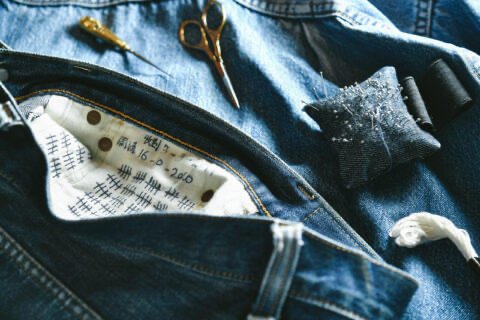
“In fact, I sealed off my sewing in 2017 when my daughter was born. This is because needles, threads, small parts and beads can be dangerous for a baby. Then last year I restarted sewing in earnest. It’s great fun!”
Mari Katayama lives in Gunma Prefecture in Japan, surrounded by rice fields and farms with her husband and daughter. It gets completely dark by 10:00 at night and this area is so quiet that the opening and closing of the front door echoes.
“My office and studio are in the grounds of a house I bought five years ago. Photoshoots and meetings are done in the studio. Although we had a family rule of not bringing work into the house, I have now ended up working on sewing in my bedroom.”
Left: ballet #002, (2013) / Right: white legs #002 (2009)
“At over 30 years old, I’ve finally learned to enjoy fashion. I think the shortcut to getting there is to understand yourself.”
Katayama had her lower legs amputated when she was nine years old due to a bone deformity. She had since been hiding her physical disability in order to live like “everyone else”. It wasn’t until she was 16 that she started creating consciously and seeing herself as an artist.
In the 1990s, before social media was widely available, Katayama was fascinated with building a personal platform on MySpace. “Back then, I had more online friends than real-life ones!” Prior to focusing on photography and painting, she was already creating through needlework. Since she needed some photos to put on her web page. She began to use her body as a “self-portrait” to display her works, which also enabled her to connect with future collaborators.
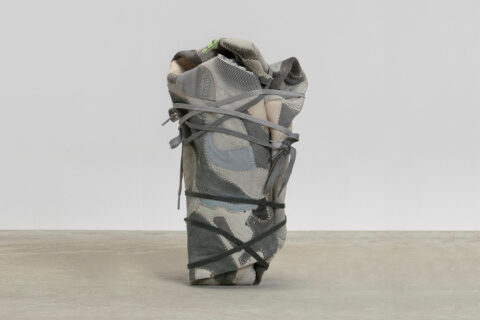
Katayama has created numerous self-portraits, embroidered items, and decorated prosthesis, using her own body as a living sculpture. Through this creative process, she has not only explored her own sense of self, but also connected with others. Just as stitching fabric pieces together allows her daily life to be linked to the broader society and world, Katayama’s art has served as a means for her to forge connections beyond her individual experience.
“I talked about the three roles of the prosthetic legs in my work, seeking, which I made when I was 16 years old. They are: walking, living and participating in society. When I was nine years old, I had both my legs amputated so that I could walk with prosthetic legs. But what I really wanted was a set of perfect, warm legs ‘just like everyone else’. I thought that prosthetic legs are only for appearance, and that I chose them as an option to go into society. Maybe I was looking for a way to satisfy the gap between reality and ideals in my own way.
In that respect, my present creative practice too involves a similar thought process. It’s about living in this society with the body, the life and the method you have right now. And you may have multiple ways forwards. There may be an alternative side of society you can live in, other than the one of two sides. For these years, I have not changed how I express the reasons for or roles of phenomena happening in society and the world in the ways I can, such as sewing, photography, writing and drawings.”
Katayama’s handmade soft sculptures span nearly 20 years of practice. Starting from mapping out her own body and reconstructing the lost parts, she painstakingly stitches the fabrics together. This process also serves as a way for her to affirm her physical form and social role. Katayama uses her own body as a model, like a mirror reflecting the realities of society.
Since Katayama’s mother and grandmother were both good at sewing and always made clothes for themselves and Katayama. That’s how she came into contact with sewing.
“Sewing is the most fundamental and important thing in my life, and it’s something I can confidently say I’m skilled at. I believe it’s very important to have something you feel confident about. The time I devote to sewing is incredibly meaningful to me, and it makes me feel wonderful. Once I start sewing, I can’t bring myself to stop, because the next piece is constantly taking shape in my mind. At times, I have to actively force myself to take a break from sewing!”
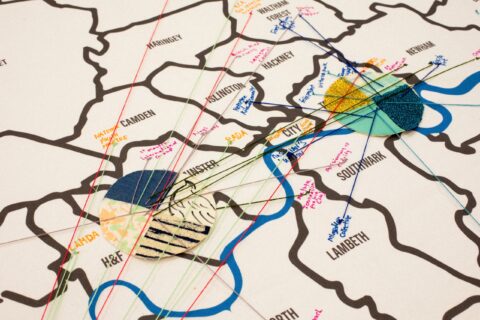
In addition to her current exhibition at the Tate Modern in London, Katayama is also working on pieces that will be showcased at the Victoria and Albert Museum next year.
Katayama has consistently used her own body – with its constantly evolving shape, size, and societal role – as a creative medium. Through this, she seeks to engage with, reflect upon, and forge connections within society, expressing her fascination and curiosity about artificial creation.
“I do not consider them as “my hand-sewn body parts” or an extension of my body. This is my body within which I create and live. Everything I experience through this body is reflected back into my works. No doubt that transformation of the body such as injury or aging is related to the transformation of the works. At the same time, our point of view also changes like the artworks. And that’s why I wish to live until I am 200 years old, so that I can witness those changes”