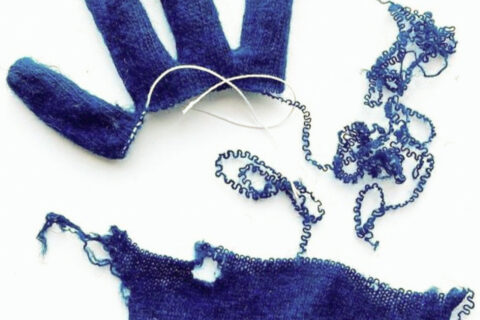
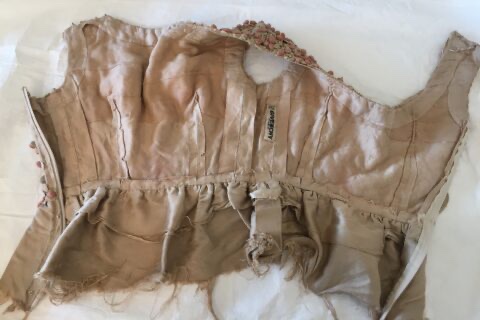
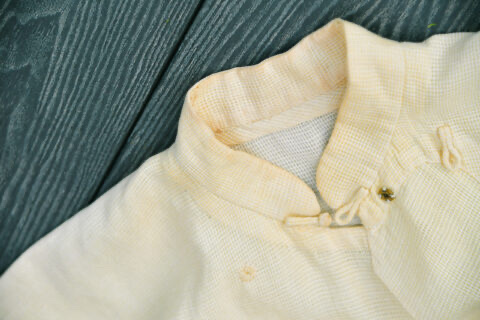
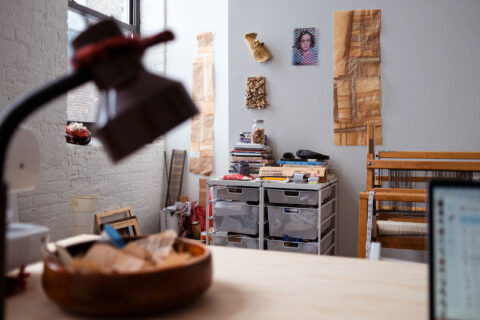
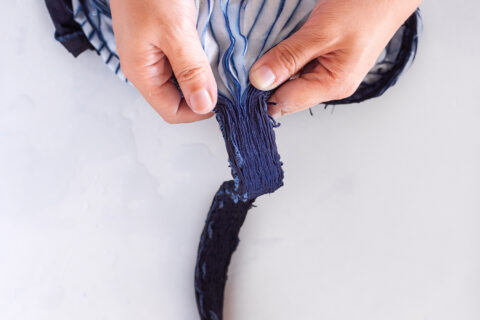
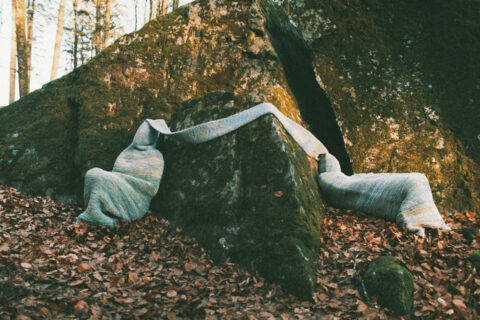
Embroidery is like painting; each stroke translates into a stitch. In my workshops, I often invite participants to sew the word “LOVE!”. This exercise incorporates fundamental embroidery techniques, including backstitch for outline, fly stitch for v-shape, chain stitch for a loop, knots for dots, either on Chinese or English.
A simple question like, “How have you been lately?” can evolve into deeper sentiments, such as, “Your father truly loves you…” This provides an outlet for feelings that are often difficult to express face-to-face.
Curry fish balls and Vitasoy embody our shared memories and cultural connections.
“The banyan tree in my ancestral home is something I’ve never seen, yet my father’s appreciation for our hometown has quietly shaped my memories.”
Mr. Sung Yukchin, now living in the UK, resonates with Li Bai’s poem, Looking at the Papaya Mountain. It brings to mind Kuk Po, with its view of Wutong Mountain, where he used to watch egrets flocking back at dusk. This vivid memory heightens his homesickness as he navigates life away from home.
These reflections stem from my visits to Birmingham, London, and Hong Kong, connecting with the “Slow Stitch Nomad.” I transform the floating memories of Hong Kong people into words, stitching them together, allowing our shared sentiments to crystallize in Kuk Po—a village where only one remains.
移民潮,是香港的源起,也似是香港的宿命,但其實在Sam Miller 的著作 “Migrants” The Story of Is All 的序言説:「從根本上來說,人類是一種遷徙物種,更甚於其他陸地上的哺乳動物。在我們存在的大部分時間裡,我們都是遊牧民族,當中有些人仍然如此。房屋和永久定居點是一個相對較晚的發展——可以追溯到一萬二千年前。邊界和護照是近代才出現的。」
The wave of migration is both the origin and destiny of Hong Kong. As Sam Miller notes in the preface of his book Migrants: The Story of Us All, “Humans are, in fundamental ways, a migratory species, more so than any other land mammal. For most of our existence, we were all nomads, and some of us still are. Houses and permanent settlements are a relatively late development—dating back little more than twelve thousand years. Borders and passports are even newer.”
Borders separate friends and family. In a time before the internet, people relied on letters for connection. A few simple words and the strength of the strokes were perhaps more profound and precious than today’s constant connectivity.
Curating “Kuk Po Get Together” has brought us—Hong Kongers—together and deepened my understanding of home. For me, home is defined by cherished people and memories. “Miss You in the Air” can also take form, making those feelings tangible.
How long has it been since you wrote a letter? Would you choose that old piece of clothing as your letterhead? Perhaps a handkerchief, school uniform, or pajamas?
“I used to wear this style of undershirt as a kid, but this one is brand new. My mom bought it for me before my first trip to the UK, but I hardly wear that style anymore!” says Anson, who is studying in the UK. Another participant, Mr. Fung uses his grandson’s old clothes to reminisce about Kuk Po’s Kai Choi School.
For Billy, stitching is a skill unlocked, evoking memories of his grandma mending clothes for him. It reminds him that this craft, which shapes our daily lives, is worth exploring and passing on. While stitching, Anson unexpectedly recalls her mom telling her that her great-grandfather supported the family by making clothes, stirring memories of the grandmother who raised her and deepening her connection to her heritage.
Each stitched piece of clothing is personal yet intertwined with collective emotions. Through embroidery, we capture the unforgettable sentiments of this moment, using fabric as a medium and thread as the connection.